

Mere saath aayegi?
It has been two and half years since I met her.
But her face still visits me at night.
I met her only once. Yet the bond we shared cannot be explained in any language.
It was a burning summer afternoon in Dangs, Gujarat. After eating our packed lunch beneath a fig tree, Chandraben, a health worker and I resumed our field visits.
“There is one patient you should meet,” she told me quietly. “Five kilometres from here.”
We rode our scooty into the village.
As we entered, I noticed Mahua flowers spread outside almost every house, drying under the sun in careful circles and rectangles. Children ran behind us. A few young mothers joined us curiously.
Chandraben led me to a mud house without doors.
Outside sat a girl.
Thin. Frail. Too weak to sit without support.
Near her lay an unwashed plate, flies hovering over the water left from rinsing hands after a meal.
A few feet away stood what they called a bathroom. Four plastic sacks tied together, with a half-broken wooden plank pretending to be a door.
When we sat down, the girl tried to stand.
With the help of a stick, she slowly dragged herself toward the washroom, fighting against the wind as though even the air was stronger than her body.
A few minutes later, her family arrived – her parents and two younger sisters.
Their faces made one thing clear, they did not want us there.
We did not share a common language. I spoke broken Hindi. Chandraben translated from Gujarati as best as she could. But some things need no translation.
The blood reports in my hand.
The silence in that house.
The indifference in her parent’s eyes.
I understood enough.
I understood how invisible some lives become.
I understood what poverty does.
I understood what happens when a girl child falls sick in a forgotten corner of this country.
Chandraben began explaining her history.
But I was listening to more than words.
I listened to helplessness.
I listened to exhaustion.
I listened to the quiet resignation in her voice.
The girl returned slowly from the washroom, trembling, trying not to collapse.
None of her family moved to help her.
Chandraben held her gently and brought her near me. I made her sit against the wall.
Then came a silence I still carry inside me.
Just me.
Her.
The buzzing flies.
The smell of infection.
The pus oozing from cracks in her palms.
It was the hardest half hour of my life.
Her name was Minu*.
She had innocent eyes clouded by mature cataracts. Her vision had already begun to disappear. A loose
faded nightdress hung over a body that was not just malnourished, but unloved.
Her sister handed me a passport sized photograph.
I stared at it for a long time.
A smiling fourteen-year old girl looked back at me. Bright eyes. Neatly dressed. Alive with dreams.
And then I looked at the girl sitting beside me.
That photograph had been taken only two years earlier.
I could not reconcile the two faces.
If I was unable to accept what had happened to her, how could she have accepted it herself?
Chandraben continued speaking.
A year earlier, Minu had fallen sick. Her symptoms were ignored.
Health workers repeatedly begged the family to take her to the hospital, but they refused. Her parents worked every day just to feed four children. The nearest hospital was three hours away. Reaching it meant losing wages, travelling by cart, and spending money they did not have.
By the time they finally took her, she was already deteriorating.
She was diagnosed with juvenile diabetes and acute pancreatitis.
Medications were given. Importance of them were explained.
She took it for a few months.
Then the treatment stopped.
Somewhere along the way, her parents stopped trying too.
They moved her outside the house, into the veranda.
Food was reduced. Sometimes denied.
They believed starving her would end her suffering and theirs.
Minu became weaker day by day.
Deficient in nutrition.
Deficient in love.
Infections spread across her body.
Her eyesight faded. Her body slowly began surrendering.
Even then, her parents refused to take her back to the hospital.
They were simply waiting for her to die.
I remember trying not to cry.
But something inside me broke that day, and I have never been able to fix it since.
Maybe I do not want to.
I begged them to let us take her.
“We will care for her,” I said. “You don’t need to spend money. You don’t need to leave work. Just send her with us.”
They stopped responding.
As if I was speaking to a wall.
I looked at Minu.
No anger.
No tears.
No resistance.
Just emptiness.
And that emptiness terrified me more than anything else.
I wanted to hold her and take her away from that place forever. I wanted to give her a bed, warm food,
medicines, affection – things so basic, yet so absent from her life.
One last time, I pleaded with her parents.
They turned their faces away.
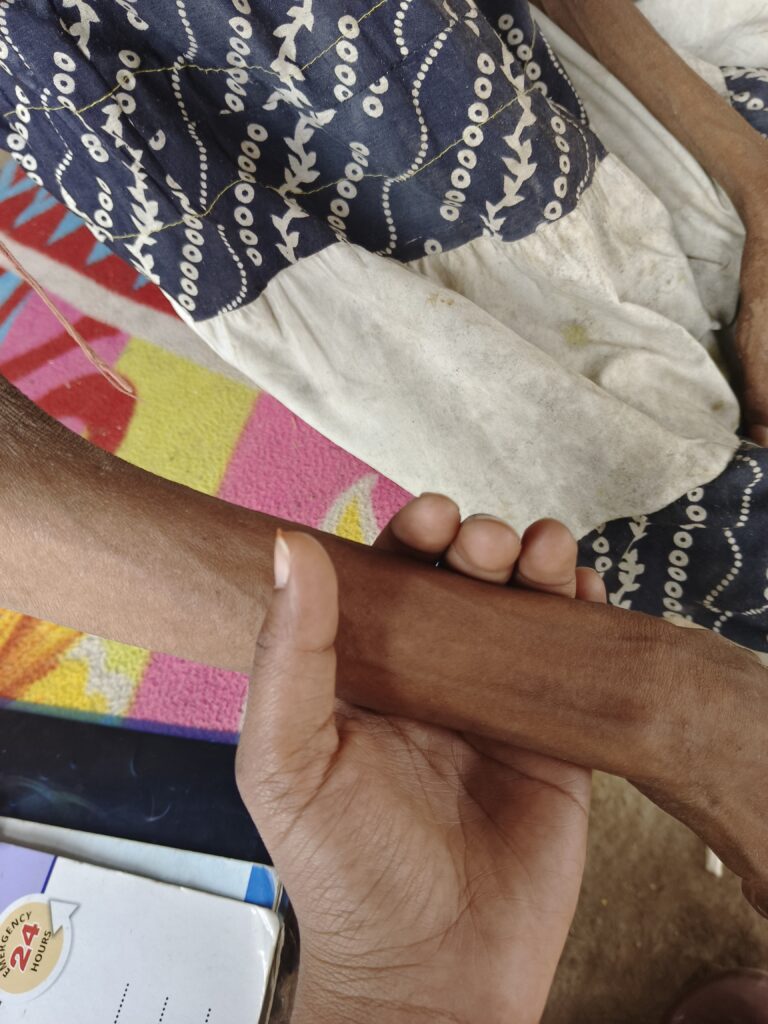
I took Minu’s hands into my lap.
Her palms were dry, cracked, bleeding with ulcers.
Her head remained lowered.
Then I asked softly,
“Mere saath aayegi?”
(Will you come with me?)
She immediately lifted her head.
For the first time, there was expression in her face.
Hope.
She nodded quickly.
That nod still haunts me.
I cried. I kissed her wounded palms.
And then I left.
A few months later, Apexa, a physiotherapist from a centre I had visited texted me.
Minu had died.
I broke once again. Sat in a dark room for many hours.
Kissed my hands which once held Minu’s, and cried uncontrollably in guilt.
I should have taken her with me
I betrayed the trust in that small nod.
I left her behind in a house that had already abandoned her long before death arrived.
Sometimes I wonder if she waited for me.
If every passing vehicle made her think I had come back.
If she believed, till the very end, that someone would finally take her away.
Even today, I cannot forgive myself for asking her that question.
“Mere saath aayegi?”
Because she said yes.
And I still left her there.
Now Minu exists everywhere around me.
I wonder, how many more Minus are hidden in the remote villages of this country?
How many girl children are silently abandoned while still alive?
How many families decide that a daughter is not worth saving?
How many villages continue to exist without access to healthcare and transport facilities?
Minu lives with me now.
Not just as a memory, but as a wound.
As a story I carry and share, to remind people how cruel society can become, how deeply systems can fail, and how easily suffering is ignored when it belongs to the poor, to the rural, to a girl child.
Minu exists everywhere around me, around us, in every injustice.
And we keep ignoring her.
*The name of the patient has been changed to protect privacy.
About the Author
I have never wanted to be identified by a name, a place, or a designation. I do not fully know why, but I have always hesitated to belong to any fixed identity. But today, I feel grateful to introduce myself as a Travel Fellow.
For a world that needs identities as introductions, I am Gayathri – Batch 4 Travel Fellow, a confused human, a traveller, a writer, and a doctor from a village in Pudukkottai district, Tamil Nadu.
I completed my undergraduate medical degree in 2021. Since then, my journey has taken me through many different spaces – volunteering with NGOs, working in a rural clinic, spending nearly a year in Auroville, undertaking a travel fellowship, teaching as a tutor in a medical college, and practising functional medicine for a few months. I am now pursuing postgraduate studies in Physiology. The travel fellowship was one of the best things that happened to me. It gave me the opportunity to witness many other sides of life, politics, and this country. It helped me become a better human being. It made me question, observe, and explore.
Even after the fellowship ended, I continue to carry the experiences, questions, and qualities it gifted me with. And Yes, I met Minu during the fellowship.