

Learning, Unlearning & Growing: RSP Reflections @ MAHAN Trust, Melghat
The Rural Sensitisation Programme (RSP) conducted at MAHAN Trust, in the dense Melghat region in Maharashtra from October 17-19, 2026, brought together a diverse cohort of 14 participants all from the medical background. Over three immersive days, the programme sought to deepen participants’ understanding of what it entails to reside in rural areas. Questions such as what are the rural healthcare realities, community dynamics, and the broader social determinants of health came up as reflections
Key Resource Persons: Dr Vasundhara Rangaswamy, AID India, Mr. Ranjit, Social Activist with Khoj, Mr. Amrut Bang, SEARCH, Gadchiroli and Mr. Nitin Wairagkar, Global Health Professional
Day 1: Building Context and Field Engagement
October 17th
Many participants had reached early and had already become comfortable with each other, and were getting to know each other. In some ways, the programme began even before the scheduled formal time.
The programme commenced with interactive energisers to get them groovy. This was followed by an icebreaker in which they had to go around in circles to connect with an object in the room and why they identify with that object. Diary, speaker, curtains etc. Now they were asked to imagine if one of them was not there in their life – just like how if in a rural area we do not have a hospital, an MBBS doctor, a nurse, a Gynaecologist, a school etc. how would it look like. With this thought to consider, Dr Ashish Satav, the founder of MAHAN Trust shared his inspirational journey of how he started MAHAN, the work they do specially in the area of malnutrition, the challenges, aspirations and what keeps the team going despite the presence of traditional healers called Bhumkas! The session also showcased MAHAN’s multifaceted interventions especially their Locally Therapeutic Food (LTF) that has positively intervened to reduce malnutrition.
After this, the participants were taken around to see the hospital, campus and the LTF unit during which time the participants also realised the challenges of living amidst nature as a few of them got stung by the honey bees 😜
Photo taken at RSP, MAHAN Trust
Once the excitement died down, the participants were then divided into groups, each given time to discuss the good practices they observed, where intervention was needed and the observations related to campus and LTF which was then discussed in the presence of Dr Ashish and Dr Vasundhara. After this exercise, lunch was served. Participants were then oriented about field-related protocols after which they were divided into two groups – each to observe one village where they were given themes to work on.
On the way, all the participants were taken to the nearest functioning sub-PHC inaugurated only a month back in Lavada where the Counsellor Programme runs which is a one-of-a-kind initiative in the country. The primary purpose of this program is to bridge the gap between Korku speaking tribal communities and public healthcare services. Members from the community are appointed in the PHC to facilitate easy coordination and access to medical care for the Korku community. Participants interacted with the counsellors, patients, doctor, nurses, lab-in-charge and ASHA workers as well to discuss their work, working conditions, facilities and challenges faced.
Photograph taken in field, RSP MAHAN
After this the two teams went to their respective villages – Rorra and Gotta where themes related to livelihood and women’s work, human-animal conflicts, Water, sanitation and nutrition and lastly Traditional, cultural and political practices were shared with participants to explore and discover led by the Project Leads and the Village Health Worker. The villages also had examples related to de-addiction, a check dam called Doh and community garden and nutritional farming which the participants were able to observe in their respective villages.
By late evening, the participants had interacted and interviewed key people related to their themes and engaged in informal cultural engagement with the community which had organised their Navratri programme. The participants along with the children and adults sang and danced to different songs.
Day 2: Understanding Systems and Field Learning
October 18th
The second day began at a relaxed pace with a short walk to the nearby lake after which reflections from the field were presented by the participants. Teams were given time to deliberate, present their observations and answer critical questions posed to them from the field visit in the presence of Dr Ashish and Dr Vasundhara. Questions on the invisibility of women’s work, intervention of technology, examples of patriarchy, rituals and superstitions relegated to only rural people, human-animal conflicts and traditional practices were deeply discussed.
Photo taken at RSP, MAHAN Trust
One of the participants rightly noted how women were absent from the informal engagement except for the village health worker who kept adjusting her saree. Both the teams discussed their villages and the issues faced by the villagers.
For many, this was their first exposure to such contexts – an experience that was both intense and transformative. The session evolved into an open dialogue that encouraged critical reflection and continuous questioning till lunch.
Post the lunch session we had Mr. Ranjith, a social activist who has closely worked in the Melghat region who discussed his journey and the positive changes that has come up in the Melghat region over time who encouraged the participants to keep a vision and stick to it and do work that satisfies them instead of only chasing money.
Post the session, we had an energiser activity after which the participants were divided into groups with a case given. The government is inviting proposals to set up a health centre in Melghat region from the government sector, private sector and the NGO sector. 2 participants were representing the Health Ministry. The groups were asked to present on
– what services they would offer, how and why?
– the type of infrastructure and the design
– HR, Board members and the stakeholders
– the perks, benefits and allowances to be provided
– the service quality checks
– the funding structure
It was interesting to see how the groups presented their proposals in a realistic and humorous way, all at the same time especially during the teams’ ongoing discussions with the health ministry who were questioning each point in their proposal.
In the late evening, we had Dr Vasundhara sharing her journey pointing out how one can follow different paths and there is so much learning to do in this one life. Dr Kavita Satav also shared her journey and how despite being a very protected child in her family she went on to work in the forests of Melghat. Two women, two different stories and lots of lessons to carry back!
We had a short reflection and feedback session for the participants and their key takeaways from the RSP which continued till dinner.
Day 3: Reflection and Way Forward
The final day began with talks by Amrut Bang, SEARCH, Gadchiroli who again shared his trajectory as a non-medico and how working in the grass-roots level is a different vibe altogether. This was followed by an interactive session with Dr Nitin Wairakar who closely works in the sphere of research and advocacy and has deeply contributed to policy changes.
The last segment was the way forward where Arunima presented RHN’s work and what the participants can consider going forward. This was followed by discussions on pathways for continued engagement. Participants were introduced to various opportunities, including:
- Travel Fellowship
- Social and Obstetrics Fellowship
- Medico Friend Circle
- Rural Hospital Network (RHN) opportunities
- Azim Premji Health Equity Fellowship etc.
After group photographs, the formal proceedings ended with a vote of thanks, followed by informal interactions.
Participants Impression of the Programme –
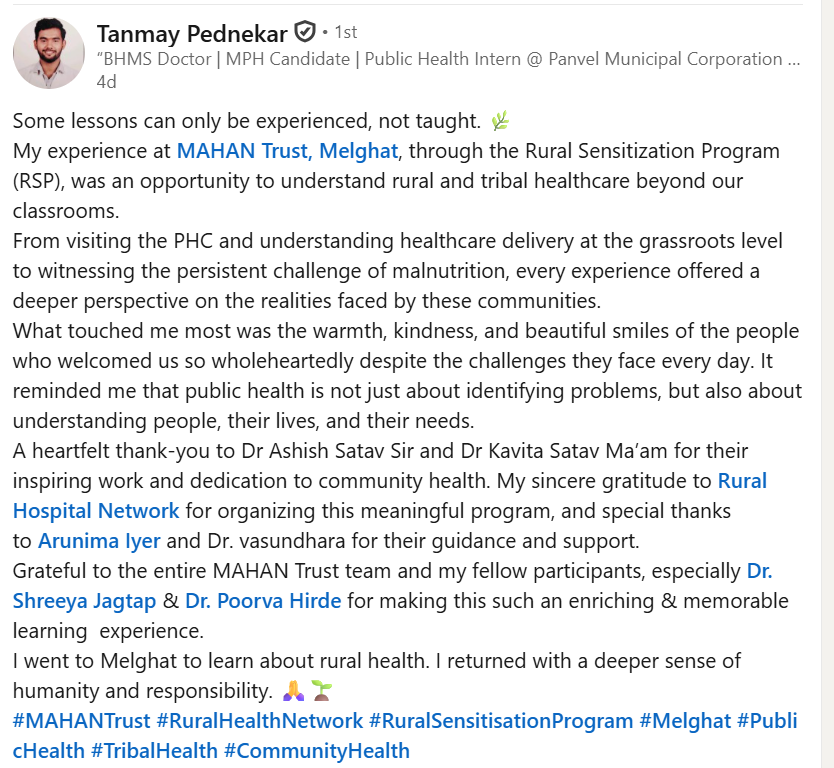
Another participant who wishes to be anonymous said – “ The RSP experience at Melghat helped me come out of my comfort zone. I realise that if you open up to others, so will they.
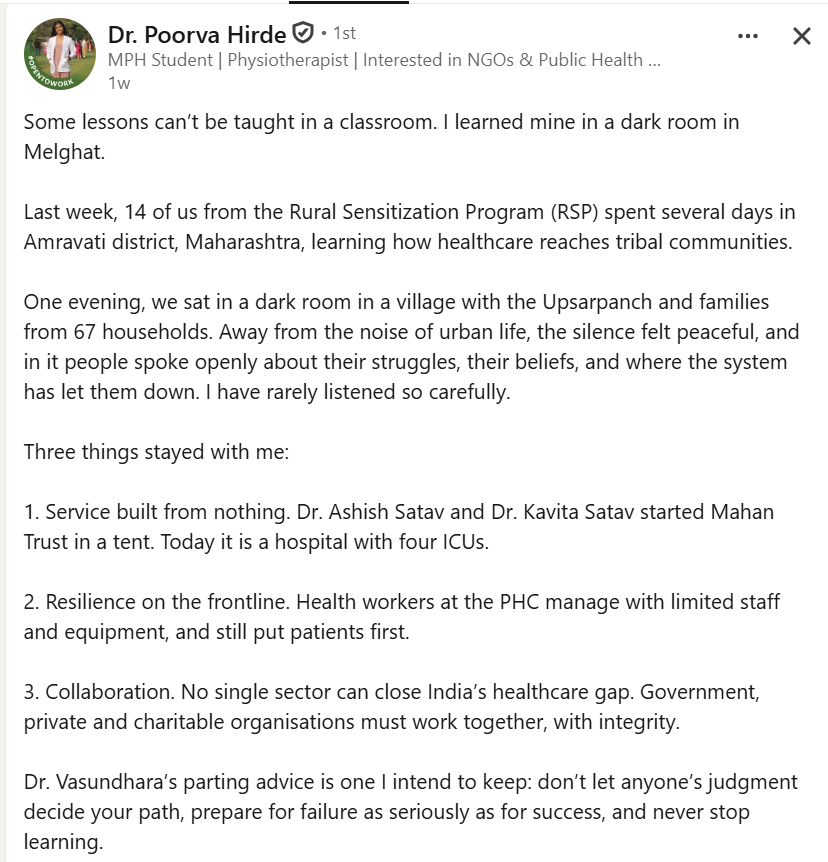
Conclusion
The RSP at Melghat was not merely an academic exercise but a transformative experience. It challenged assumptions, broadened perspectives, and instilled a deeper sense of responsibility among participants. The participants felt the need to focus beyond hospitals and urban centres to reach the underserved and unheard communities.
Photo taken at RSP, MAHAN Trust
_________________________________________________________________________________________________________