

Post RSP Reflections, IDO, Gattumalla, Telangana
Rural Sensitisation Programme (RSP)
Indigenous Development Organization (IDO), Gattumalla, Telangana
March 13–15, 2026
The Rural Sensitisation Programme (RSP) conducted at the Indigenous Development Organisation (IDO), Gattumalla, Telangana, from March 13-15, 2026, brought together a diverse cohort of 17 participants (9 from medical and 8 from non-medical backgrounds). Over three immersive days, the programme sought to deepen participants’ understanding of rural healthcare realities, community dynamics, and the broader social determinants of health.
Day 1: Building Context and Understanding Systems
March 13th
The programme commenced with a light meditation session, setting a reflective tone for the days ahead. Participants then engaged in an interactive icebreaker in which, in groups of three, they introduced each other after learning about their backgrounds, motivations, and aspirations. Each group was tasked with identifying a shared interest, which led to discussions on themes such as rural healthcare, compassion, and travel.
Participants were then invited to individually define “health” based on their own understanding and asked to revisit this definition at the end of the programme – an exercise designed to capture the evolution of their perspectives over the three days.
Picture taken at the Workshop, IDO Gattumalla
The context-setting session followed, led by Dr Nandakumar Menon, who elaborated on RSP’s vision, history, and relevance in bridging the gap between medical education and rural realities. This was complemented by an insightful session from Dr Kapil Sharma, who shared the journey of establishing the IDO health facility.
Dr Sharma traced the origins of his work with the Gutti Koya community, an internally displaced population that migrated from conflict-affected regions of Chhattisgarh during the Naxal movement and the Salwa Judum operations 25 years ago. He highlighted the challenges of building trust within the community, where modern healthcare is gradually penetrating, while deep-rooted reliance on traditional healers persists.
Picture taken at the Workshop, IDO Gattumalla
The session also showcased IDO’s multifaceted interventions, including:
- Establishment of bridge schools in remote hamlets
- Introduction of water rollers to ease in collecting and transporting water
- Solar-powered electricity solutions
- Mobile medical units reaching last-mile populations
- A backpack for the health workers labelled with instructions to use the tools while they visit remote hamlets and many others
Participants were then divided into groups, each mentored and assigned specific areas within the health facility for observation: the training hall and community farming; the operation theatre, laboratory, and pharmacy; and the OP/IP wards. After exploring these units, participants reflected on operational challenges, resource constraints, and opportunities for affordable innovations.
Creative group presentations followed, using charts, poems, and narratives to convey their learnings. This was succeeded by a “Walk of Privilege” activity, which enabled participants to reflect on social inequalities and the varying starting points individuals have in life. The discussions that followed explored inequities in healthcare access and the need for inclusive systems.
A thought-provoking video by Chimamanda Ngozi Adichie on “The Danger of a Single Story” encouraged participants to question biases and embrace nuanced understanding. The day concluded with informal cultural interaction with community members through song and dance.
Day 2: Community Immersion and Field Learning
March 14th
The second day began early with an orientation, after which participants were divided into four groups and visited three hamlets: Kranthinagar, Rallacheluka, and Bussera.
Each group engaged with specific focus areas:
- Community Health Worker systems
- Bridge schools
- Families and patients
- Traditional healthcare practices
Photo taken at the Field Site, IDO Gattumalla
Participants were also assigned individual tasks such as interacting with nurses, speaking with children about education, engaging with adolescents, and understanding women’s daily routines, including food practices.
From 7 AM onwards, participants spent the morning immersed in the villages, supported by IDO health workers who facilitated communication. For many, this was their first exposure to such contexts – an experience that was both intense and transformative.
Upon return, participants presented their observations, leading to deep discussions around:
- Challenges faced by the Community
- The role and legitimacy of traditional medicine
- Ethical questions around intervention without disrupting cultural ecosystems
The session evolved into an open dialogue that encouraged critical reflection and continuous questioning.
Day 3: Reflection, Reframing, and Way Forward
The final day began with meditation, followed by participants revisiting their initial definitions of health. The reflections revealed a significant shift – from viewing health as a clinical or individual concept to understanding it as deeply interconnected with social, cultural, and environmental factors.
This was followed by discussions on pathways for continued engagement. Participants were introduced to various opportunities, including:
- Travel Fellowship
- Social and Obstetrics Fellowship
- Medico Friend Circle
- Rural Hospital Network (RHN)
- Azim Premji Health Equity Fellowship
Opportunities for non-medical participants were also highlighted, reinforcing the interdisciplinary nature of rural development.
The programme concluded with a feedback session where participants shared their expectations, key takeaways, and intended actions moving forward. After group photographs, the formal proceedings ended with a vote of thanks, followed by informal interactions.
Picture taken at the Workshop, IDO Gattumalla
Participants Impression of the Programme –
“Working with the community, not just for them”
I recently had the incredible opportunity 🤩 to attend the Rural Sensitisation Program (RSP) organized by the Indigenous Development Organisation – I DO at Gattumalla, Bhadradri Kothagudem, Telangana. It included a lot of unlearning, learning, and deep reflection.
🤩🎯 My key takeaways 👇
🌟 Sustainable Simplicity: Seeing how high-impact, simple solutions like Water rollers* and Bridge schools* can fundamentally change daily life.
🌟The Power of Proximity: To create real change.. we must work with the community as partners, rather than treating them as passive beneficiaries.
🌟The Strength of the Teamwork: Witnessing the beauty of teamwork and how people are united by a cause. – Dr. Amani Talasila, Public Health Professional
—————————
“There is a certain humility that comes from witnessing medicine practised in places where resources are limited, but commitment is abundant. It reminded me that medicine is not only about treating the disease, but about bringing care, respect, and possibility to communities that have long been distant from it.” – AK Dhivya Prabha, Medical Student
—————————
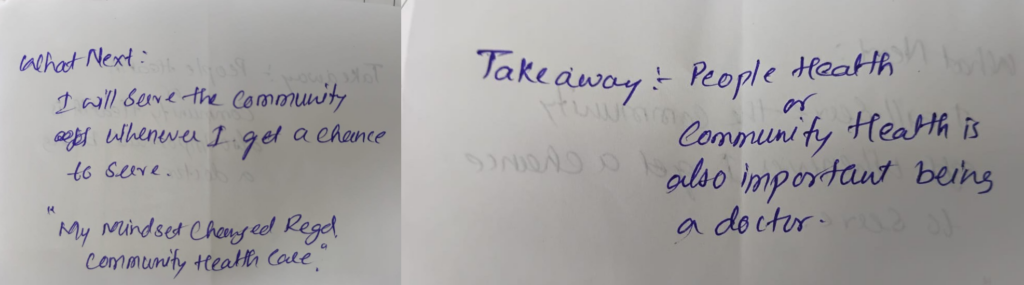
– Anonymous Participant
Conclusion
The RSP at Gattumalla was not merely an academic exercise but a transformative experience. It challenged assumptions, broadened perspectives, and instilled a deeper sense of responsibility among participants.
It reaffirmed that healthcare must extend beyond hospitals and urban centres to reach underserved and unheard communities. More importantly, it emphasised that meaningful engagement requires humility, cultural sensitivity, and sustained commitment.
Picture taken at IDO, Gattumalla
From the RHN Team
Last updated on 11th April 2026
________________________________________________________________________________________________________________